
Working out at home? Get these 3 bits of kit
Make the most of the Black Friday sales. If you're just starting out with working out at home and want to make the most of the black friday sales, here are my top 3 recommendations.
Ollie Booth
11/28/20256 min read
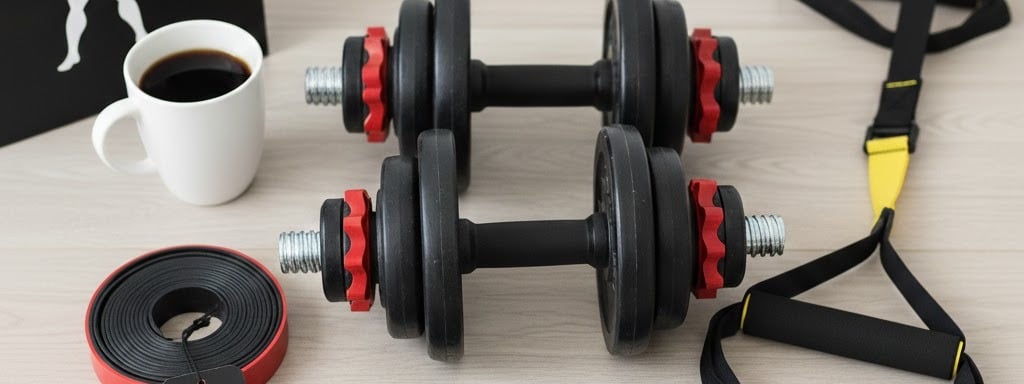
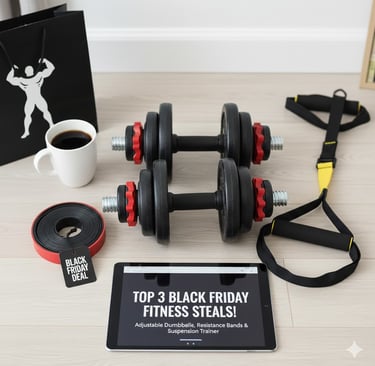
If you’re starting your fitness journey at home, choosing the right equipment can feel a bit overwhelming. The good news? You only need a few key pieces to build strength, improve fitness, and create effective beginner home workouts.
In this blog post, we'll cover what fitness levels this blog caters for, the main things you need to consider before choosing and the pros and cons of each recommendation.
Making the decision can be tricky, so feel free to drop me a message. I'd be more than happy to help out. Equally, if you need to get a programme together, I can also help with this.
Who is this blog post for?
Most people! The adaptability of these bits of kit means they can cater to any age and most levels. If you know you're pretty strong, then sure, this blog isn't going to apply too much. But everyone else, keep reading.
What do you need to consider?
How to put a well-balanced programme together, how much variety you want from each bit of kit and your budget. Don't worry, I'll talk you through it all.
Movement patterns
Bodyweight workouts with no equipment are ok. But in the long run, you're going to build imbalances which will likely lead to injury (and probably a lot of boredom due to lack of exercise variety!)
Muscles generally work in pairs. If you're working the front of the thighs (the quadriceps), you also want to be working the back of the thighs (the hamstrings) to balance out your strength. You might get away with squats and lunges for the quadriceps, but you'll struggle to train the hamstrings without equipment.
To summarise what we want to cover in a session, we want to think in movement patterns. As a starting point, you want to include at least:
Lower body push - front thigh dominant, think squats, lunges, etc
Lower body pull - back thigh dominant, think deadlift, leg curl, etc
Upper body push - chest and backs of arms, think press-up variations
Upper body pull - back and front of arms, think row type movements
Core - plank, crunches, rotation work, etc
Intensity
To make progress, we need to be making small steps forward. Lifting more weight, for more reps or increasing the time of an exercise. Making sure your kit allows you to do this is going to be essential if you want to see progress.
Variety
Because storage space and budget are considerations, you want to be thinking about covering all the movement patterns and giving you lots of options. This will influence which bits of kit you need.
Budget
This post covers a range of budgets. If you can, I encourage you to think of any purchases as a long-term investment. The goal is to be exercising in some form for the rest of your life! If it is a pricier option, think about how that cost would be spread across 10, 20, 30 years, etc.
Let's get to the equipment.
1. Resistance Bands
The 2 types I'm going to talk about are Tube Bands with handles and Long Loop Bands (or Power Bands) as they're the most relevant in terms of being able to get a well-rounded workout in.
Tube Bands
They offer a bit more exercise variety and enough resistance for most people. But as strength improves or if you're naturally stronger than average, you'll want to go for the stronger Long Loop Bands.
Long Loop Bands
As mentioned, these are more appropriate for higher strength levels. But the slight downside is that you will miss out on a couple of exercise variations when compared to the Tube Bands.
Here are a few examples of some of the exercises you can do:
2. Adjustable Dumbbells
If you're willing to make a bit more of an investment, then I really would recommend getting some adjustable dumbbells.
At this stage, definitely go for adjustable rather than lots of different pairs of fixed weights. This is if you're working at the right intensity, you're going to need lots of different weight options. Buying a pair of 4kg dumbbells may work for some bicep curls, but then they'll be nowhere near heavy enough for some bent-over rows.
What to look for
With the adjustable dumbbells, there are a ton of options. The key things to look out for are:
- Weight increments (the difference in jumps up in weight e.g. 2kg, 4kg, 6kg). You want to have increments of 2kg or less. Just as any bigger than this makes the jumps up in weight quite big.
- Durability. If you want to chuck them around then you'll need to go for heavy-duty ones. But for normal use, go for ones with as few plastic components as possible.
- The length. Some will be the same length for all weight increments, whereas others will vary in length depending on the weight. This is more of a personal preference/price thing. However, one slight benefit of the ones that vary in length is that they’ll have a flat end. This can be useful for certain exercises e.g. a dumbbell press, where you start with resting the dumbbells on the thighs.
- Around 20kg dumbbells will cover most people.
Adjustable Dumbbell Pros
Quick and easy set up
Really easy to be consistent and see progress
Some people prefer the feel of the resistance compared to resistance bands
Adjustable Dumbbell Cons
Cost - they are more of an investment, but definitely worth it if you think about how long they'll last you
Recommended Products*
Again, loads of options with these. But Eisenlink Adjustable Dumbbells are my choice. They have a 2kg increment, flat ends (which are good for some exercises) and a super simple design, which will mean they'll last forever. The only thing to consider is that they are a bit slower to adjust when making big weight changes when compared to quick-adjustment dumbbells. Still much faster than the traditional spin lock design. I have a pair in the studio and another pair that I use for home visits.
FitBeast Resistance Bands Set
Again, loads of great options out there. These are the ones I currently use in the studio and for home PT sessions, great quality and very good value.
3. Suspension Trainer
Back to a lower cost item, the suspension trainer uses your body weight as the resistance. All you need is a door that opens away from you as you face it or a sturdy back/front door.
Here are a few example exercises:
In summary
It's really worth putting a bit of thought into those first purchases. I often see people waste money on the wrong thing and get demotivated with exercising at home right out of the gate.
If you can afford it, I'd go with adjustable dumbbells. But, I appreciate it's a bit of an investment. If it's too much, then I'd start with the bands, adding a suspension trainer later on for some variety if needed.
If you need any help picking the right option for you or want help getting a home workout programme together, I'd be more than happy to help.
*Note, if you do purchase any products with the recommended link, I do make a small commission but rest assured, it's definitely not enough to sell my soul! Any products I recommend are products that I currently use in my PT sessions or that members have used at home.

Resistance Band Pros
Very cost-effective
Can easily fit in a suitcase
Don't necessarily need anything extra to attach to (anchor points e.g. a door)
Resistance Band Cons
Some people prefer the more consistent feel of weights (when you pull a resistance band, it starts light then gets harder)
Being consistent can be tricky (where you hold/stand on the bands can affect how much resistance you're pulling)
Recommended Products*
*Note, if you do purchase any products with the recommended link, I do make a small commission but rest assured, it's definitely not enough to sell my soul! Any products I recommend are products that I currently use in my PT sessions or that members have used at home.
COFOF Resistance Bands Set with Handles
Loads of variations of this style. Very good value without compromising on quality. I often get these for members who are starting to work out at home.
Like the bands, the Suspension trainer is very portable and can give you a great variety of exercises.
Suspension Trainer Pros
Cost
Portability
Variations for the upper body
Useful for balance/support with leg exercise if you're struggling with leg strength/balance
Suspension trainer Cons
Limited leg exercise choices for people who are not advanced (so you probably want to have either the bands or dumbbells as well)
Recommended Products*
I have used well-known suspension trainer brands in the past, but I found them way overpriced and actually lacking in some areas. For me, the RHINOSPORT suspension trainer ticks the value box and I like the fact that you have the options to attach the anchor point of each handle either together or separately. Again, these feature in my studio.

Ollie Booth Fitness
Personal Trainer Horsham
© 2026. All rights reserved.
LOCATION - Enterprise House, Foundry Lane, Horsham
CONTACT